


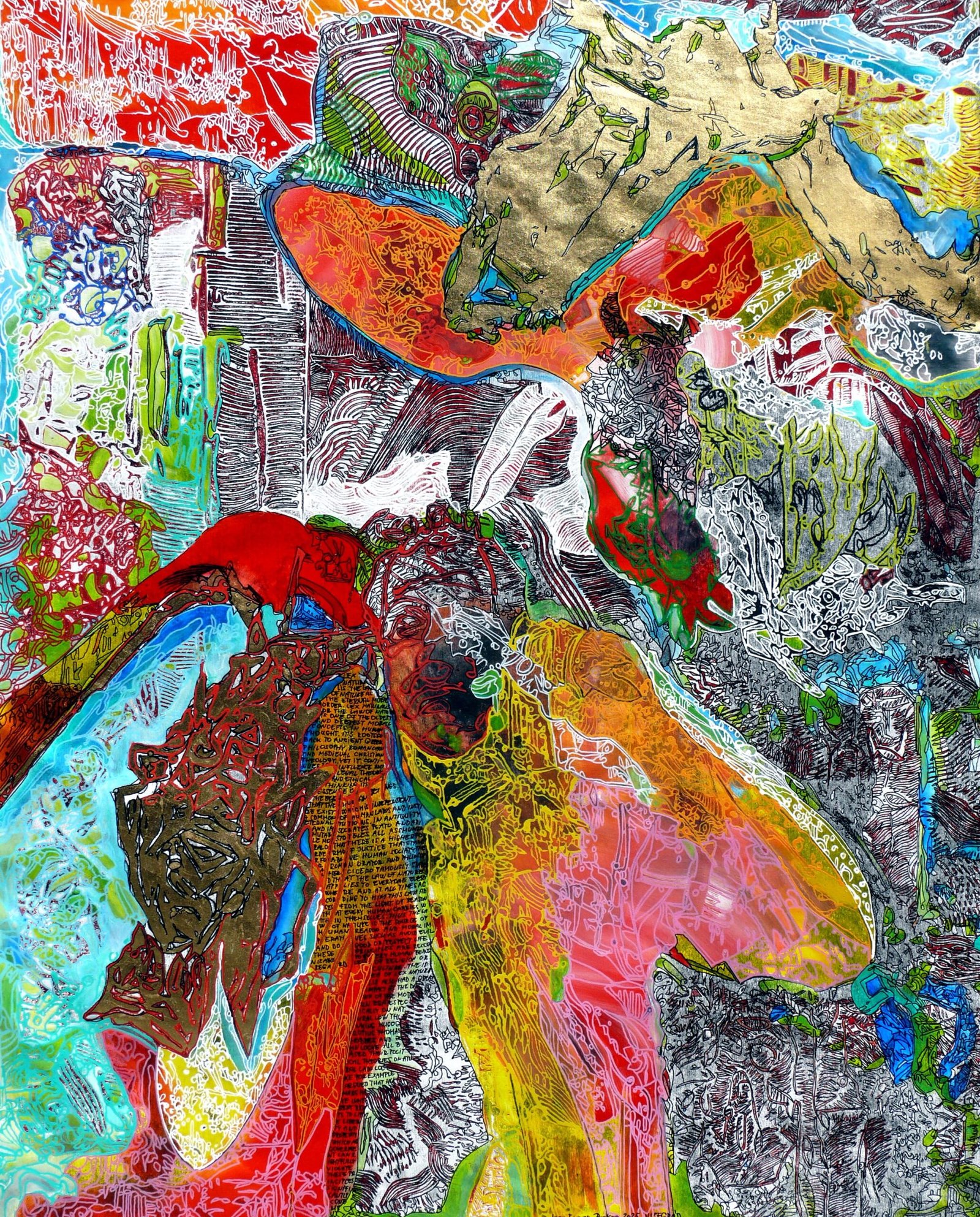
Igor Eugen Prokop has built an artistic career around questions that rarely have straightforward answers. His work moves between the worlds of art and science, drawing on biology, philosophy, environmental awareness, technology and his own extensive experiences across different cultures and landscapes. Rather than limiting his practice to one subject or medium, Prokop uses art as a space where different forms of knowledge can meet.
The result is an oeuvre that asks viewers to look beyond the surface of an image. His paintings can be visually striking and richly imaginative, but they often contain concerns about the direction of contemporary civilisation. Nature, scientific discovery, artificial intelligence and human behaviour become interconnected subjects through which he examines the challenges facing society.
A Multidisciplinary Foundation
Prokop was born in Budapest in 1953. His education took an unconventional route, beginning with dental technology before moving toward art and biology education in Eger from 1974 to 1978. His later interests continued to expand, encompassing biology, philosophy, film aesthetics, design management, and environmental protection.
Rather than treating these subjects as isolated areas of study, Prokop gradually incorporated elements of each into his creative outlook. Scientific thinking gave him an appreciation for observation and natural systems, while philosophy encouraged him to consider the meaning behind what he observed. Art provided the freedom to bring these different perspectives together.
This background helps explain why his paintings often resist simple categorisation. They can contain references to biological structures, natural phenomena, cultural symbolism and technological development, yet they remain open to personal interpretation.
Travel as an Artistic Education
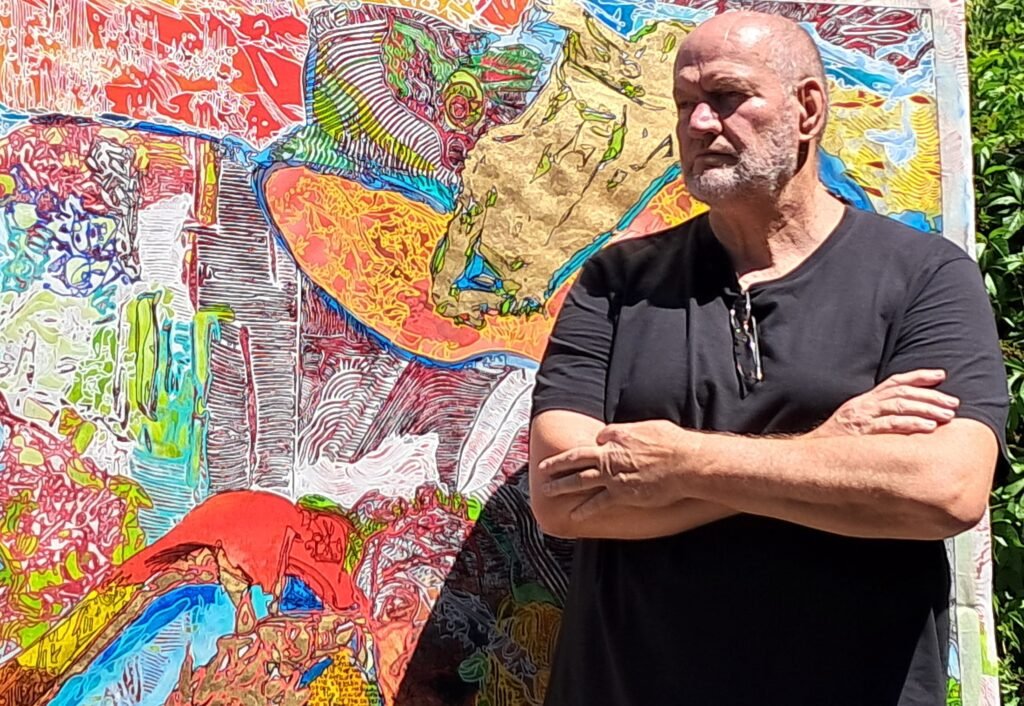
The world beyond the studio has been another important influence on Prokop’s development. His travels have taken him across Europe as well as North America, Australia, New Zealand, Asia and Oceania.
Such experiences offered him encounters with environments and societies that differed dramatically from his own. Tropical regions, coral ecosystems, islands and distinctive cultural traditions became opportunities to observe the enormous variety of life and human expression.
For an artist with a background in biology, these journeys could also be understood as fieldwork of a kind. Prokop encountered nature directly, studying its complexity while becoming increasingly aware of how vulnerable many natural systems have become.
That awareness can be felt throughout his artistic practice. The natural world in his paintings is not simply a collection of attractive shapes or colours. It carries questions about survival, balance and the consequences of human intervention.
When Nature Becomes a Question
One of the most compelling qualities of Prokop’s work is the contrast between visual attraction and underlying concern.
His compositions can initially appear playful, colourful or mysterious. A closer examination, however, often reveals references to environmental disruption, technological change or the uncertain future of humanity.
This duality is central to his approach. Instead of creating direct illustrations of environmental problems or scientific theories, Prokop translates complicated ideas into visual metaphors.
A biological form can suggest transformation. A technological symbol can become a comment on human ambition. A distorted natural image can communicate instability.
In this way, the paintings encourage viewers to form their own connections rather than receiving a predetermined interpretation.
Experimenting With Glass, Light and Form
Prokop’s artistic exploration is not confined to traditional approaches to painting. His work with glass and fusing techniques has allowed him to investigate the expressive possibilities of transparency, reflection and illumination.
Glass introduces a different relationship between artwork and viewer. Light can pass through, reflect from, or interact with the material, making the surface appear to change according to its surroundings.
This interest in light complements Prokop’s broader fascination with transformation. His work frequently explores states that are neither completely one thing nor another: organic yet artificial, familiar yet strange, beautiful yet unsettling.
Material experimentation therefore becomes more than a technical exercise. It supports the conceptual questions that drive his practice.
Imagining a World Shaped by Artificial Intelligence
Technology has become an increasingly prominent concern in Prokop’s recent works. Among the subjects he examines is the emergence of artificial intelligence and what it could mean for humanity’s traditional understanding of intelligence and reason.
The Last Supper AI: The Dethronement of Reason is an example of this approach. By placing the idea of artificial intelligence alongside one of the most recognisable images in Western cultural history, Prokop creates a confrontation between inherited human traditions and a rapidly changing technological reality.
The work invites consideration of a difficult possibility: if machines become capable of increasingly advanced forms of reasoning, how should humanity understand its own intellectual position?
Other works approach transformation from different directions. Alien Healing Virus uses a biological premise to explore ideas surrounding change and adaptation, while Upside Down The Melting Climate Dogs employs an altered natural world to evoke the instability associated with climate change.
The subjects may differ, but the underlying concern remains connected: how does humanity respond when the systems it depends upon begin to change?
The Ethical Dimension of Lex Naturalis
These questions can also be considered through the philosophical tradition of Lex Naturalis, or natural law.
The concept has a long history extending from ancient Greek philosophy through Roman thought and medieval theology. At its heart is the belief that moral principles can exist beyond the laws created by particular governments or societies.
Thinkers such as Socrates, Plato, and Aristotle considered justice in relation to a higher order of truth, while Cicero developed the idea of a universal law connected to reason and applicable beyond individual political systems.
Viewed in relation to Prokop’s artistic concerns, natural law introduces another important dimension.
Humanity has acquired extraordinary abilities through science and technology. Yet the ability to change the natural world does not automatically answer the ethical question of whether those changes should be made.
This distinction is particularly relevant in an age of artificial intelligence, genetic research, environmental transformation and increasingly powerful technologies.
Prokop’s work can therefore be read as an invitation to reconsider the relationship between knowledge and responsibility.
A Civilization at a Turning Point
The tension between technological progress and natural systems appears repeatedly in Prokop’s artistic thinking.
Modern civilisation has become increasingly capable of controlling and modifying its environment. At the same time, environmental crises demonstrate that such control has consequences. Artificial intelligence introduces another layer to the discussion by challenging traditional assumptions about intelligence itself.
These developments raise fundamental questions.
Can progress exist without responsibility? Can technology develop without changing the society that created it? Can humanity continue to treat nature as something separate from itself?
Prokop does not attempt to settle these debates through his paintings. Instead, he gives them visual form.
That approach allows his work to remain relevant even as specific technologies and environmental circumstances change.
A Career Shaped by International Exchange
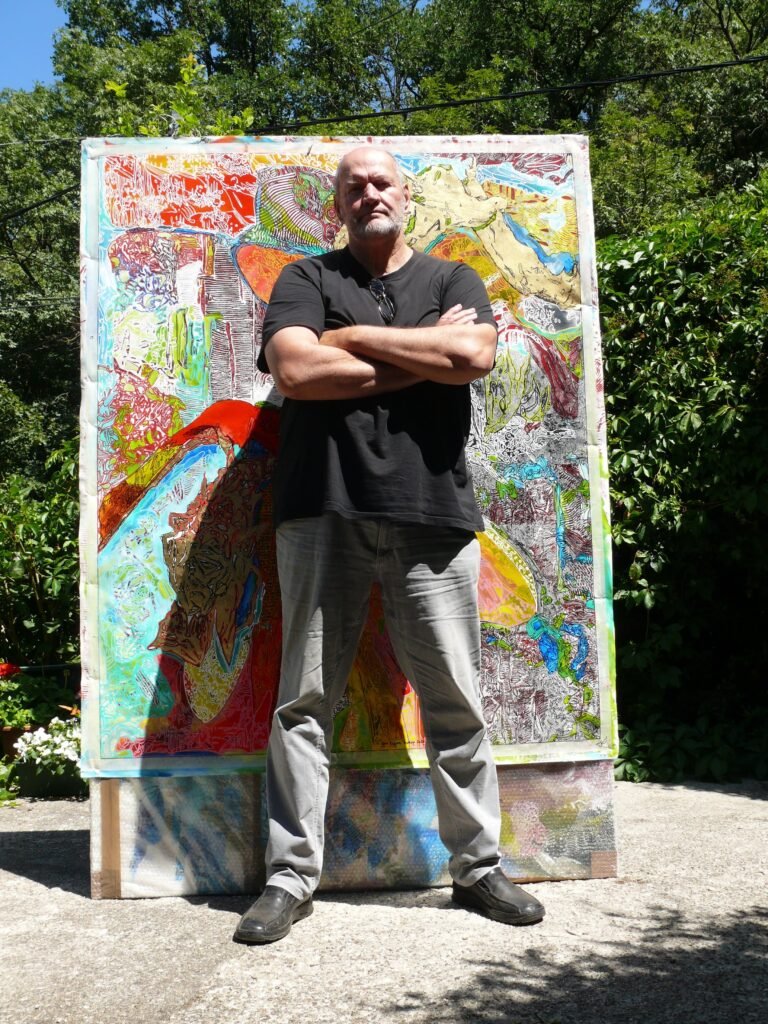
Prokop’s artistic career has developed through a wide range of international exhibitions. His works have been shown in European and overseas locations including Budapest, Berlin, Heidelberg, Salzburg, Vienna, Toronto, Auckland, Cambridge and Montreal.
He has also received recognition through international artistic events and awards, including distinctions connected with the Chianciano Biennale, the London Art Biennale and the Andrea Mantegna International Award in Mantua.
His international exposure is consistent with the expansive character of his practice. Just as his ideas cross disciplinary boundaries, his artistic journey has crossed geographical and cultural ones.
Creating Images That Stay With the Viewer
Perhaps the most distinctive feature of Prokop’s work is that the paintings do not end when the viewer understands what is represented.
A familiar symbol may lead to an unfamiliar question. An image inspired by nature may ultimately become a meditation on technology. A visually beautiful composition may contain an uncomfortable warning.
This layered quality gives his work its ability to remain in the mind.
Rather than demanding one interpretation, Prokop’s paintings allow different readings to coexist. A viewer interested in ecology may discover one meaning, while another may focus on philosophy, biology, technology or the psychological dimension of the work.
The Future as an Open Question
Igor Eugen Prokop’s art ultimately returns to a subject larger than any individual painting: the future of humanity.
His multidisciplinary background has given him a vocabulary that extends beyond conventional artistic categories. Biology provides an understanding of living systems. Philosophy supplies questions about ethics and existence. Travel provides firsthand encounters with different environments and cultures. Material experimentation adds another dimension through glass, light and colour. Contemporary technology provides new territory for reflection.
Together, these influences create an artistic practice concerned less with describing the present than with examining where the present might lead.
Prokop’s paintings do not predict the future. They ask viewers to consider their role in creating it.
In an era defined by environmental uncertainty and rapid technological development, that invitation has particular significance. His work reminds us that scientific capability, artistic imagination and moral responsibility cannot exist entirely apart from one another.
Ultimately, Igor Eugen Prokop’s art occupies the space between observation and questioning. It encourages us to look carefully at the natural world, examine the technologies we create and reconsider the assumptions that define our understanding of humanity.
The answers remain unresolved.
And that may be precisely the point.
