


Holly Wong is a contemporary artist whose work exists at the intersection of memory, mythology, and transformation. Through collaged paintings and fiber installations, she constructs layered visual narratives that speak to healing as an active, evolving process. Rooted in personal experience yet expansive in scope, Wong’s practice examines how the body, the mind, and cultural memory can be reclaimed, reimagined, and ultimately transformed.
Based in San Francisco, Wong has developed a distinct mixed media language that bridges material experimentation with emotional depth. Her work moves fluidly between grounded, earth-bound imagery and ethereal, ascending forms, reflecting a journey from trauma toward resilience, illumination, and possibility.
An Artistic Foundation Shaped by Inquiry and Experience
Wong holds an MFA from the San Francisco Art Institute, an environment known for encouraging conceptual rigor and material exploration. This foundation is evident in her fearless approach to media and her commitment to process-driven work. Rather than treating materials as passive tools, Wong allows them to actively shape meaning. Oil paint, graphite, alcohol ink, candle smoke, and fiber are layered, cut, burned, and assembled to form surfaces that feel both physical and psychological.
Her practice draws inspiration from mythology, neuroscience, and embodied memory. These influences converge in works that resemble maps of inner terrain, topographies that echo the brain’s pathways, emotional imprints, and the nonlinear nature of healing. Memory, in Wong’s work, is never static. It shifts, rises, fragments, and reforms.
Memory as Material and Method
Central to Holly Wong’s artistic philosophy is the idea that memory can be worked with rather than simply endured. She treats memory as both subject and material, something that can be cut apart, layered, obscured, and brought back into light. This approach aligns with her broader exploration of personal reclamation, the act of taking ownership of one’s narrative and reshaping it through conscious engagement.
Wong’s surfaces often bear traces of time and touch. Hand-cut elements suggest care and deliberation, while smoke stains and fluid inks introduce unpredictability. These contrasts mirror the tension between control and surrender that defines many healing processes. Through this balance, Wong invites viewers to reflect on their own memories and the ways they continue to shape identity.
Evolution From Grounded Healing to Ascending Imagery
Over time, Wong’s visual language has evolved from heavier, earth-bound forms toward increasingly luminous and ascending compositions. Earlier works often feel anchored, dense, and rooted in the physical body. More recent pieces, by contrast, reach upward, evoking air, light, and expansion.
This shift does not represent an escape from the past, but rather a transformation of it. Memory becomes something that can lift rather than weigh down. The imagery suggests ascension without erasure, acknowledging pain while allowing it to transmute into clarity, strength, and openness.
This evolution reflects Wong’s belief that healing is not linear. It is layered, recursive, and deeply personal. Her work visualizes this complexity with sensitivity and honesty.
Lamp of Memory 3: Radical Healing and Ascension
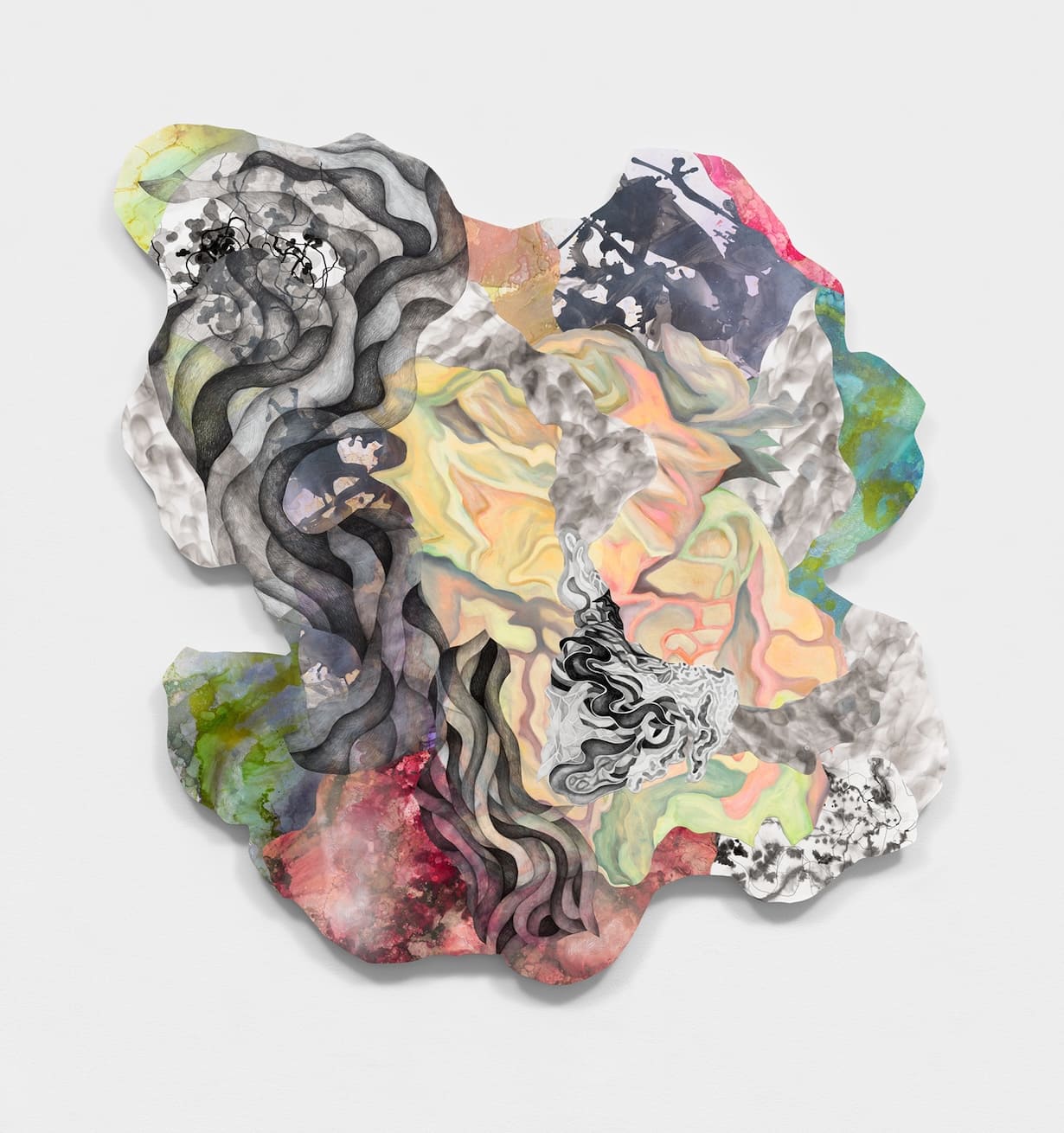
Lamp of Memory 3 exemplifies many of the core themes present in Wong’s practice. Created as a collaged painting on shaped aluminum, the work explores radical healing through both material choice and conceptual framing. Aluminum provides a reflective, industrial surface that contrasts with the organic qualities of smoke, ink, and hand-cut paint, reinforcing the dialogue between permanence and transformation.
Drawing from John Ruskin’s ideas about cultural preservation, the piece reimagines memory as something alive and ascending rather than fixed or burdensome. Light becomes a central metaphor. Instead of illuminating from above, it rises from within, suggesting memory as a generative force capable of change.
The layered materials evoke the topography of the brain, folds, pathways, and intersections that echo neural networks and emotional recall. Candle smoke introduces a sense of ritual and impermanence, while alcohol ink flows unpredictably, mirroring the way memories surface and dissolve. Together, these elements create a composition that feels both anatomical and spiritual.
Open Possibility and Luminous Recall
In Lamp of Memory 3, Wong presents memory as airborne and expansive. The composition reaches upward, moving beyond containment toward open space. This visual ascent reflects a state of possibility, where the past no longer defines limits but becomes a source of illumination.
Rather than offering resolution, the work holds space for transformation. It invites viewers to consider their own relationship to memory, what they carry, what they release, and what they allow to rise. In doing so, Wong’s work becomes not only reflective but participatory, offering a quiet yet powerful invitation to healing.
Recognition, Exhibitions, and Impact
Holly Wong’s work has been widely exhibited and recognized for its emotional depth and conceptual strength. Her exhibitions include presentations at the de Young Museum, the Marin Museum of Contemporary Art, and the Contemporary Jewish Museum, among others. These venues reflect the broad resonance of her work across institutional, cultural, and community-focused spaces.
A Presidential Scholar in the Arts, Wong has also received grants from the California Arts Council, the Puffin Foundation, and the George Sugarman Foundation. She is represented by galleries in Oakland, Philadelphia, Houston, and Denver, underscoring her national presence within the contemporary art landscape.
A Practice Rooted in Transformation
At its core, Holly Wong’s practice is an act of care toward memory, toward the body, and toward the possibilities that emerge when past experiences are reexamined with compassion. Her work does not shy away from complexity or vulnerability. Instead, it transforms them into sources of strength and light.
Through layered materials and ascending forms, Wong offers a visual language for healing that is both intimate and expansive. Her art reminds us that memory, when engaged with intention, can become not a weight, but a lamp, guiding, luminous, and alive.
